 Add to Chrome
 Add to Firefox
 Add to Edge
Photoplethysmography Ppg
Photoplethysmography (PPG) is a non-invasive optical technique used to measure blood volume changes in the microvascular bed of tissue.
Papers and Code
Benchmarking and Enhancing PPG-Based Cuffless Blood Pressure Estimation Methods
Feb 04, 2026
Cuffless blood pressure screening based on easily acquired photoplethysmography (PPG) signals offers a practical pathway toward scalable cardiovascular health assessment. Despite rapid progress, existing PPG-based blood pressure estimation models have not consistently achieved the established clinical numerical limits such as AAMI/ISO 81060-2, and prior evaluations often lack the rigorous experimental controls necessary for valid clinical assessment. Moreover, the publicly available datasets commonly used are heterogeneous and lack physiologically controlled conditions for fair benchmarking. To enable fair benchmarking under physiologically controlled conditions, we created a standardized benchmarking subset NBPDB comprising 101,453 high-quality PPG segments from 1,103 healthy adults, derived from MIMIC-III and VitalDB. Using this dataset, we systematically benchmarked several state-of-the-art PPG-based models. The results showed that none of the evaluated models met the AAMI/ISO 81060-2 accuracy requirements (mean error $<$ 5 mmHg and standard deviation $<$ 8 mmHg). To improve model accuracy, we modified these models and added patient demographic data such as age, sex, and body mass index as additional inputs. Our modifications consistently improved performance across all models. In particular, the MInception model reduced error by 23\% after adding the demographic data and yielded mean absolute errors of 4.75 mmHg (SBP) and 2.90 mmHg (DBP), achieves accuracy comparable to the numerical limits defined by AAMI/ISO accuracy standards. Our results show that existing PPG-based BP estimation models lack clinical practicality under standardized conditions, while incorporating demographic information markedly improves their accuracy and physiological validity.

Aortic Valve Disease Detection from PPG via Physiology-Informed Self-Supervised Learning
Feb 04, 2026Traditional diagnosis of aortic valve disease relies on echocardiography, but its cost and required expertise limit its use in large-scale early screening. Photoplethysmography (PPG) has emerged as a promising screening modality due to its widespread availability in wearable devices and its ability to reflect underlying hemodynamic dynamics. However, the extreme scarcity of gold-standard labeled PPG data severely constrains the effectiveness of data-driven approaches. To address this challenge, we propose and validate a new paradigm, Physiology-Guided Self-Supervised Learning (PG-SSL), aimed at unlocking the value of large-scale unlabeled PPG data for efficient screening of Aortic Stenosis (AS) and Aortic Regurgitation (AR). Using over 170,000 unlabeled PPG samples from the UK Biobank, we formalize clinical knowledge into a set of PPG morphological phenotypes and construct a pulse pattern recognition proxy task for self-supervised pre-training. A dual-branch, gated-fusion architecture is then employed for efficient fine-tuning on a small labeled subset. The proposed PG-SSL framework achieves AUCs of 0.765 and 0.776 for AS and AR screening, respectively, significantly outperforming supervised baselines trained on limited labeled data. Multivariable analysis further validates the model output as an independent digital biomarker with sustained prognostic value after adjustment for standard clinical risk factors. This study demonstrates that PG-SSL provides an effective, domain knowledge-driven solution to label scarcity in medical artificial intelligence and shows strong potential for enabling low-cost, large-scale early screening of aortic valve disease.
SIGMA-PPG: Statistical-prior Informed Generative Masking Architecture for PPG Foundation Model
Jan 28, 2026Current foundation model for photoplethysmography (PPG) signals is challenged by the intrinsic redundancy and noise of the signal. Standard masked modeling often yields trivial solutions while contrastive methods lack morphological precision. To address these limitations, we propose a Statistical-prior Informed Generative Masking Architecture (SIGMA-PPG), a generative foundation model featuring a Prior-Guided Adversarial Masking mechanism, where a reinforcement learning-driven teacher leverages statistical priors to create challenging learning paths that prevent overfitting to noise. We also incorporate a semantic consistency constraint via vector quantization to ensure that physiologically identical waveforms (even those altered by recording artifacts or minor perturbations) map to shared indices. This enhances codebook semantic density and eliminates redundant feature structures. Pre-trained on over 120,000 hours of data, SIGMA-PPG achieves superior average performance compared to five state-of-the-art baselines across 12 diverse downstream tasks. The code is available at https://github.com/ZonghengGuo/SigmaPPG.
Wavelet-Driven Masked Multiscale Reconstruction for PPG Foundation Models
Jan 18, 2026Wearable foundation models have the potential to transform digital health by learning transferable representations from large-scale biosignals collected in everyday settings. While recent progress has been made in large-scale pretraining, most approaches overlook the spectral structure of photoplethysmography (PPG) signals, wherein physiological rhythms unfold across multiple frequency bands. Motivated by the insight that many downstream health-related tasks depend on multi-resolution features spanning fine-grained waveform morphology to global rhythmic dynamics, we introduce Masked Multiscale Reconstruction (MMR) for PPG representation learning - a self-supervised pretraining framework that explicitly learns from hierarchical time-frequency scales of PPG data. The pretraining task is designed to reconstruct randomly masked out coefficients obtained from a wavelet-based multiresolution decomposition of PPG signals, forcing the transformer encoder to integrate information across temporal and spectral scales. We pretrain our model with MMR using ~17 million unlabeled 10-second PPG segments from ~32,000 smartwatch users. On 17 of 19 diverse health-related tasks, MMR trained on large-scale wearable PPG data improves over or matches state-of-the-art open-source PPG foundation models, time-series foundation models, and other self-supervised baselines. Extensive analysis of our learned embeddings and systematic ablations underscores the value of wavelet-based representations, showing that they capture robust and physiologically-grounded features. Together, these results highlight the potential of MMR as a step toward generalizable PPG foundation models.
EvoMorph: Counterfactual Explanations for Continuous Time-Series Extrinsic Regression Applied to Photoplethysmography
Jan 15, 2026Wearable devices enable continuous, population-scale monitoring of physiological signals, such as photoplethysmography (PPG), creating new opportunities for data-driven clinical assessment. Time-series extrinsic regression (TSER) models increasingly leverage PPG signals to estimate clinically relevant outcomes, including heart rate, respiratory rate, and oxygen saturation. For clinical reasoning and trust, however, single point estimates alone are insufficient: clinicians must also understand whether predictions are stable under physiologically plausible variations and to what extent realistic, attainable changes in physiological signals would meaningfully alter a model's prediction. Counterfactual explanations (CFE) address these "what-if" questions, yet existing time series CFE generation methods are largely restricted to classification, overlook waveform morphology, and often produce physiologically implausible signals, limiting their applicability to continuous biomedical time series. To address these limitations, we introduce EvoMorph, a multi-objective evolutionary framework for generating physiologically plausible and diverse CFE for TSER applications. EvoMorph optimizes morphology-aware objectives defined on interpretable signal descriptors and applies transformations to preserve the waveform structure. We evaluated EvoMorph on three PPG datasets (heart rate, respiratory rate, and oxygen saturation) against a nearest-unlike-neighbor baseline. In addition, in a case study, we evaluated EvoMorph as a tool for uncertainty quantification by relating counterfactual sensitivity to bootstrap-ensemble uncertainty and data-density measures. Overall, EvoMorph enables the generation of physiologically-aware counterfactuals for continuous biomedical signals and supports uncertainty-aware interpretability, advancing trustworthy model analysis for clinical time-series applications.
PMB-NN: Physiology-Centred Hybrid AI for Personalized Hemodynamic Monitoring from Photoplethysmography
Dec 11, 2025Continuous monitoring of blood pressure (BP) and hemodynamic parameters such as peripheral resistance (R) and arterial compliance (C) are critical for early vascular dysfunction detection. While photoplethysmography (PPG) wearables has gained popularity, existing data-driven methods for BP estimation lack interpretability. We advanced our previously proposed physiology-centered hybrid AI method-Physiological Model-Based Neural Network (PMB-NN)-in blood pressure estimation, that unifies deep learning with a 2-element Windkessel based model parameterized by R and C acting as physics constraints. The PMB-NN model was trained in a subject-specific manner using PPG-derived timing features, while demographic information was used to infer an intermediate variable: cardiac output. We validated the model on 10 healthy adults performing static and cycling activities across two days for model's day-to-day robustness, benchmarked against deep learning (DL) models (FCNN, CNN-LSTM, Transformer) and standalone Windkessel based physiological model (PM). Validation was conducted on three perspectives: accuracy, interpretability and plausibility. PMB-NN achieved systolic BP accuracy (MAE: 7.2 mmHg) comparable to DL benchmarks, diastolic performance (MAE: 3.9 mmHg) lower than DL models. However, PMB-NN exhibited higher physiological plausibility than both DL baselines and PM, suggesting that the hybrid architecture unifies and enhances the respective merits of physiological principles and data-driven techniques. Beyond BP, PMB-NN identified R (ME: 0.15 mmHg$\cdot$s/ml) and C (ME: -0.35 ml/mmHg) during training with accuracy similar to PM, demonstrating that the embedded physiological constraints confer interpretability to the hybrid AI framework. These results position PMB-NN as a balanced, physiologically grounded alternative to purely data-driven approaches for daily hemodynamic monitoring.
Hybrid Modeling of Photoplethysmography for Non-invasive Monitoring of Cardiovascular Parameters
Nov 18, 2025Continuous cardiovascular monitoring can play a key role in precision health. However, some fundamental cardiac biomarkers of interest, including stroke volume and cardiac output, require invasive measurements, e.g., arterial pressure waveforms (APW). As a non-invasive alternative, photoplethysmography (PPG) measurements are routinely collected in hospital settings. Unfortunately, the prediction of key cardiac biomarkers from PPG instead of APW remains an open challenge, further complicated by the scarcity of annotated PPG measurements. As a solution, we propose a hybrid approach that uses hemodynamic simulations and unlabeled clinical data to estimate cardiovascular biomarkers directly from PPG signals. Our hybrid model combines a conditional variational autoencoder trained on paired PPG-APW data with a conditional density estimator of cardiac biomarkers trained on labeled simulated APW segments. As a key result, our experiments demonstrate that the proposed approach can detect fluctuations of cardiac output and stroke volume and outperform a supervised baseline in monitoring temporal changes in these biomarkers.
A Machine Learning-Based Multimodal Framework for Wearable Sensor-Based Archery Action Recognition and Stress Estimation
Nov 18, 2025In precision sports such as archery, athletes' performance depends on both biomechanical stability and psychological resilience. Traditional motion analysis systems are often expensive and intrusive, limiting their use in natural training environments. To address this limitation, we propose a machine learning-based multimodal framework that integrates wearable sensor data for simultaneous action recognition and stress estimation. Using a self-developed wrist-worn device equipped with an accelerometer and photoplethysmography (PPG) sensor, we collected synchronized motion and physiological data during real archery sessions. For motion recognition, we introduce a novel feature--Smoothed Differential Acceleration (SmoothDiff)--and employ a Long Short-Term Memory (LSTM) model to identify motion phases, achieving 96.8% accuracy and 95.9% F1-score. For stress estimation, we extract heart rate variability (HRV) features from PPG signals and apply a Multi-Layer Perceptron (MLP) classifier, achieving 80% accuracy in distinguishing high- and low-stress levels. The proposed framework demonstrates that integrating motion and physiological sensing can provide meaningful insights into athletes' technical and mental states. This approach offers a foundation for developing intelligent, real-time feedback systems for training optimization in archery and other precision sports.
Synheart Emotion: Privacy-Preserving On-Device Emotion Recognition from Biosignals
Nov 09, 2025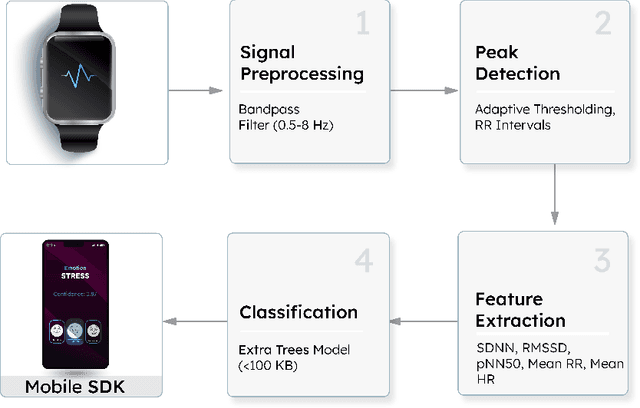

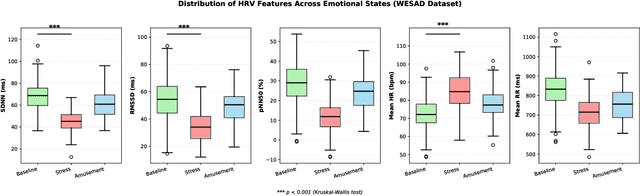
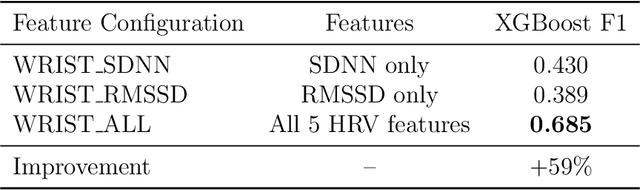
Human-computer interaction increasingly demands systems that recognize not only explicit user inputs but also implicit emotional states. While substantial progress has been made in affective computing, most emotion recognition systems rely on cloud-based inference, introducing privacy vulnerabilities and latency constraints unsuitable for real-time applications. This work presents a comprehensive evaluation of machine learning architectures for on-device emotion recognition from wrist-based photoplethysmography (PPG), systematically comparing different models spanning classical ensemble methods, deep neural networks, and transformers on the WESAD stress detection dataset. Results demonstrate that classical ensemble methods substantially outperform deep learning on small physiological datasets, with ExtraTrees achieving F1 = 0.826 on combined features and F1 = 0.623 on wrist-only features, compared to transformers achieving only F1 = 0.509-0.577. We deploy the wrist-only ExtraTrees model optimized via ONNX conversion, achieving a 4.08 MB footprint, 0.05 ms inference latency, and 152x speedup over the original implementation. Furthermore, ONNX optimization yields a 30.5% average storage reduction and 40.1x inference speedup, highlighting the feasibility of privacy-preserving on-device emotion recognition for real-world wearables.
A Hybrid Deep Learning Model for Robust Biometric Authentication from Low-Frame-Rate PPG Signals
Nov 06, 2025Photoplethysmography (PPG) signals, which measure changes in blood volume in the skin using light, have recently gained attention in biometric authentication because of their non-invasive acquisition, inherent liveness detection, and suitability for low-cost wearable devices. However, PPG signal quality is challenged by motion artifacts, illumination changes, and inter-subject physiological variability, making robust feature extraction and classification crucial. This study proposes a lightweight and cost-effective biometric authentication framework based on PPG signals extracted from low-frame-rate fingertip videos. The CFIHSR dataset, comprising PPG recordings from 46 subjects at a sampling rate of 14 Hz, is employed for evaluation. The raw PPG signals undergo a standard preprocessing pipeline involving baseline drift removal, motion artifact suppression using Principal Component Analysis (PCA), bandpass filtering, Fourier-based resampling, and amplitude normalization. To generate robust representations, each one-dimensional PPG segment is converted into a two-dimensional time-frequency scalogram via the Continuous Wavelet Transform (CWT), effectively capturing transient cardiovascular dynamics. We developed a hybrid deep learning model, termed CVT-ConvMixer-LSTM, by combining spatial features from the Convolutional Vision Transformer (CVT) and ConvMixer branches with temporal features from a Long Short-Term Memory network (LSTM). The experimental results on 46 subjects demonstrate an authentication accuracy of 98%, validating the robustness of the model to noise and variability between subjects. Due to its efficiency, scalability, and inherent liveness detection capability, the proposed system is well-suited for real-world mobile and embedded biometric security applications.